Explore how Chrome's built-in Gemini Nano model uses semantic HTML and the accessibility tree to enable private, on-device AI conversations on websites.
Imagine visiting an online store and having a private, completely offline chat with the page. You could ask about return policies or compare models, and the website would answer instantly, without sending any data to external servers. This is becoming a reality as Google builds its Gemini Nano artificial intelligence model directly into the Chrome browser.
This shift is redefining search engine optimization. Before the AI can speak for your website, it has to read it. Chrome does this by building a semantic map of your page. First, it looks at your layout and semantic HTML. Tags like headings and paragraphs are no longer just for styling; they are the building blocks of the conversation.
Next, Chrome reads your site through its accessibility tree, the same system used by screen readers. This means your accessibility labels and image descriptions are no longer just compliance checkboxes. They are direct instructions telling the AI exactly what your page elements mean and how they function.
Once Chrome understands your page, it processes the conversation locally on the user's device. There is no remote server to optimize for. The quality of the AI's response depends entirely on how well you structure your content. To prepare for this new era, we must focus on profound semantic clarity. By building accessible, well-structured pages, we ensure our websites can truly speak for themselves.
What will they talk about?
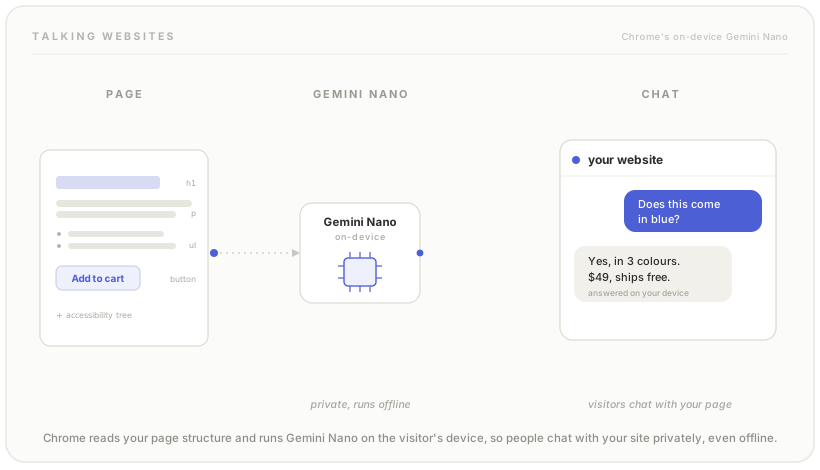
Imagine this: a user lands on your e-commerce product page. Instead of scrolling, they open a chat sidebar in their browser and ask, “What’s the return policy on this?” “Does this come in blue?” “Compare this to the other model I was looking at.”
And your website answers. Instantly. Privately. Offline.
This isn’t a third-party chatbot. This is Chrome’s built-in Gemini Nano model, acting as an intelligent interface directly to your content. The conversation is happening, with or without you. What your website “says” in that chat is determined not by a script you wrote, but by how deeply the browser understands your page.
APIPrimary FunctionInputOutputKey FeatureLanguageModelGeneral-purpose prompting and generationText, Image, AudioText / Structured TextMultimodality, Conversation, JSON Schema outputWriterGenerate new textText promptText (String)Control over absolute tone, format, lengthRewriterModify existing textTextText (String)Control over relative tone, format, lengthSummarizerCondense long textTextText (String)Specific summary types (TLDR, key points)ProofreaderCorrect grammar and spellingTextStructured Correction DataDetailed, structured error analysisTranslatorTranslate textTextText (String)Language-to-language conversionLanguageDetectorIdentify language(s)TextLanguage codes + confidenceLanguage identification with confidence scoresChrome is now armed with powerful new AI features and ready to go. Chat, write, rewrite, summarize, proofread, translate and soon, much more than that.
I’ve been analyzing the internal mechanisms Chrome uses to make this happen, and it’s a game-changer. The way Google parses your page for its on-device AI isn’t just a glimpse into the future; it’s a blueprint for optimizing for all conversational AI, from assistants to the next generation of search.
Welcome to the new era of SEO. Let’s break down the code.
Part 1: The AI’s “Eyes” – How Gemini Reads Your Page (Content Extraction & Accessibility)
Before Gemini can “speak” for your website, it has to “read” it. This isn’t the simple text extraction of old. Chrome performs a two-stage process that’s more like building a semantic brain map of your page.
Part 2: The AI’s “Brain” – On-Device Inference (The WebNN Engine)
So, Chrome has this perfect, structured understanding of your page. What happens next? This is where the magic of on-device AI comes in.
Part 3: The AI’s “Voice” – The Application Layer (The Conversational Interface)
This is where it all comes together for the user.
Your New Job Title is “AI Conversation Designer”
No, I’m just kidding. We don’t need any more titles, but it is another hat to wear.
The panic around AI in SEO is understandable, but it’s focused on the wrong things. We’ve been chasing algorithms when the real shift is happening right inside the browser.
The future of SEO isn’t about gaming vector databases. It’s about architecting content with such profound semantic clarity that it can hold a coherent, accurate, and helpful conversation with an AI agent.
Everything you’ve learned about semantic HTML, clear content structure, and accessibility is the foundation. Now, it’s time to apply that knowledge not just to rank on a results page, but to empower your website to speak for itself.
The conversation is starting. Make sure your website has something intelligent to say.
The integration of on-device models like Gemini Nano into the Chrome browser necessitates a robust pipeline for parsing, understanding, and structuring web content. This process transforms a visually rendered webpage into a machine-readable, semantically rich format suitable for AI inference. This analysis details the key Blink modules and the technical data flow, from the rendered page to the AI’s input context.
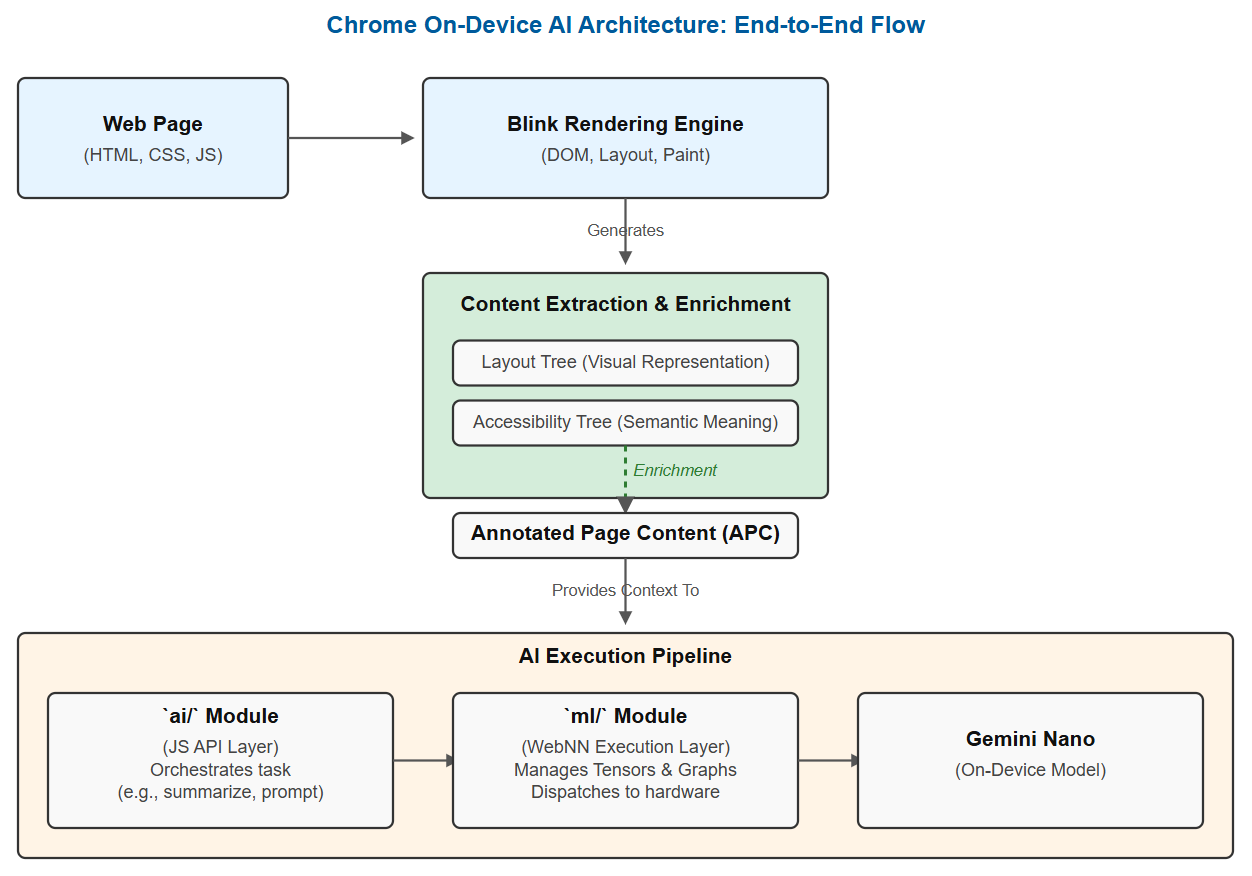
The pipeline involves a layered system where rendering primitives provide the foundation for semantic analysis and content extraction, which in turn prepare the data for the AI’s application and execution layers.
The foundational input for this entire process is not the raw DOM Tree, but the Layout Tree.
The on-device AI’s understanding begins with what is visually present. The core extraction process, therefore, traverses the Layout Tree, ensuring that non-rendered elements and their subtrees are naturally excluded from the primary analysis.
The central data structure generated from the page is the Annotated Page Content (APC). This is not a simple text scrape but a hierarchical representation of the page, managed by the content_extraction module.
The primary class responsible for this is AIPageContentAgent, which utilizes a ContentBuilder to walk the Layout Tree. This process generates a tree of ContentNodes, each populated with ContentAttributes that describe the corresponding page element in detail.
Key extracted attributes for each ContentNode include:
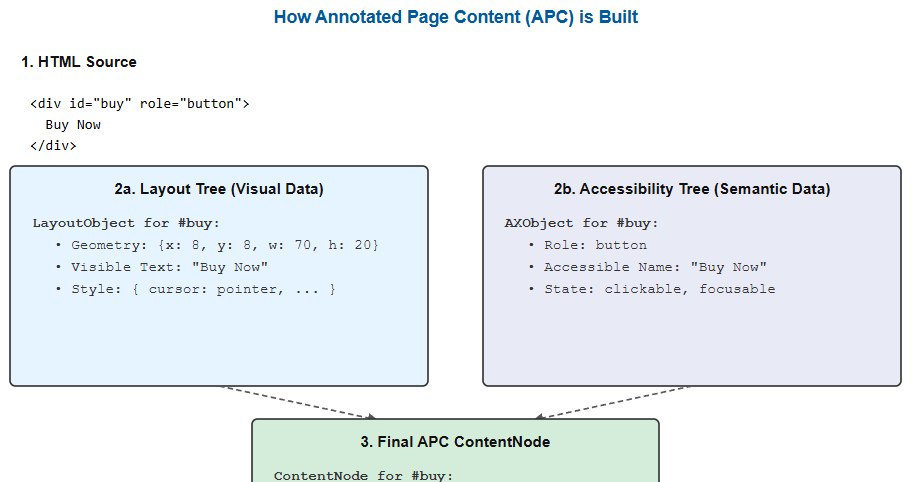
The APC’s richness and accuracy are significantly enhanced by data from the accessibility/ module. The Content Extraction process is not isolated; it actively queries the Accessibility Tree to infuse its data structure with deeper semantic meaning.
The Accessibility Tree, managed by AXObjectCacheImpl, creates a hierarchy of AXObjects that represent the semantic roles and properties of UI elements. The AIPageContentAgent directly depends on this.
The key points of integration are:
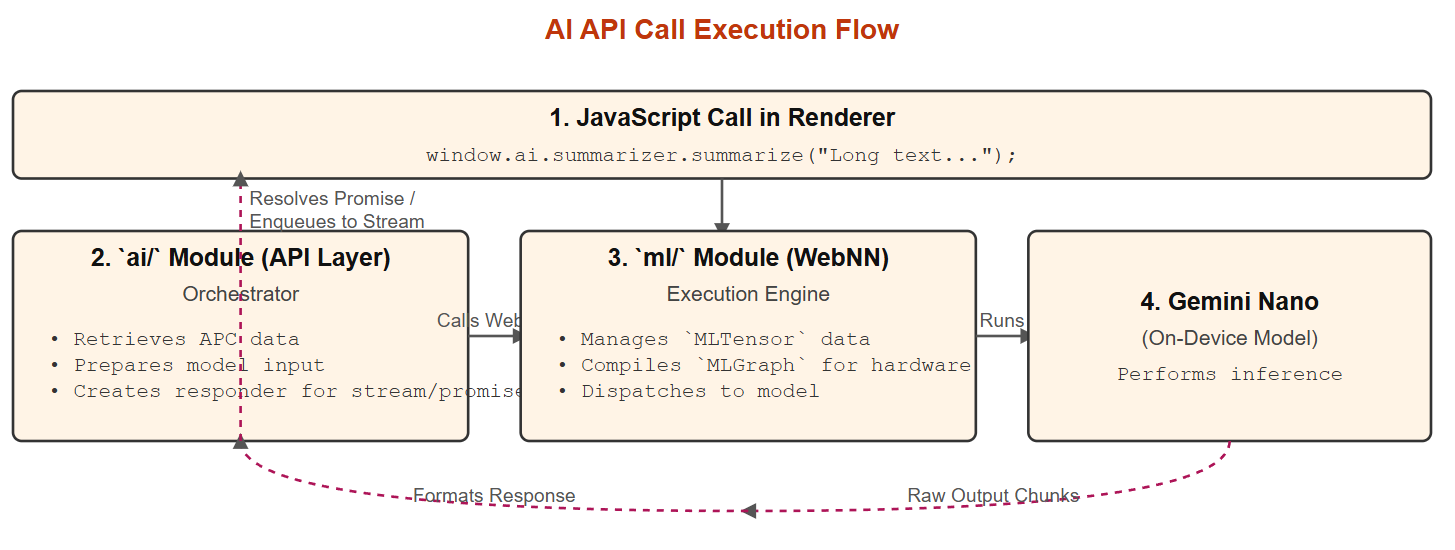
Once the semantically enriched APC is available, the AI modules take over.
The process is a data-flow pipeline with dependencies, primarily triggered after the browser’s rendering lifecycle has stabilized.
This architecture demonstrates a clear design pattern: content is progressively enriched, moving from a raw structural representation (DOM) to a visual one (Layout), then to a deeply semantic one (Accessibility), before being packaged into a comprehensive data structure (APC) for direct use by on-device AI.
 Dan Petrovic ·
Aug 21, 14:00
Dan Petrovic ·
Aug 21, 14:00
Sign in with Google to comment.