An analysis of how AI search rankers use semantic alignment to surface different content zones within a single article based on query specificity and intent.
When you search the web using AI, you might think the system recommends an entire article. In reality, AI search engines rank and surface specific passages based on exactly how a question is asked.
To see how this works, researchers tested seven different search queries against a single health article about teas for ulcerative colitis. The article had two main parts: a large section with detailed tea recommendations, and a smaller section with general lifestyle tips.
Six of the queries were broad, like asking for lifestyle changes. For all six, the search ranker only pulled from the generic tips section. But when a highly specific query was used—one that mentioned a specific medication—the system finally unlocked the detailed tea recommendations. Furthermore, when a query asked what to avoid, it pulled out negative caffeine warnings that positive queries completely missed.
This shows that your content exists as a semantic map, and the search ranker is just finding the closest matching point. If your audience searches with broad questions, they will only see your broad, generic tips. To get your deep expertise noticed, you have to bridge the gap. You must structure your writing so your specific details are framed with the broad terms and different search angles people actually use.
A single article. Seven different queries. Radically different passages surfaced.
This isn’t a bug. It’s the ranker doing exactly what it’s supposed to do—and it reveals something important about how content actually gets discovered in AI search.
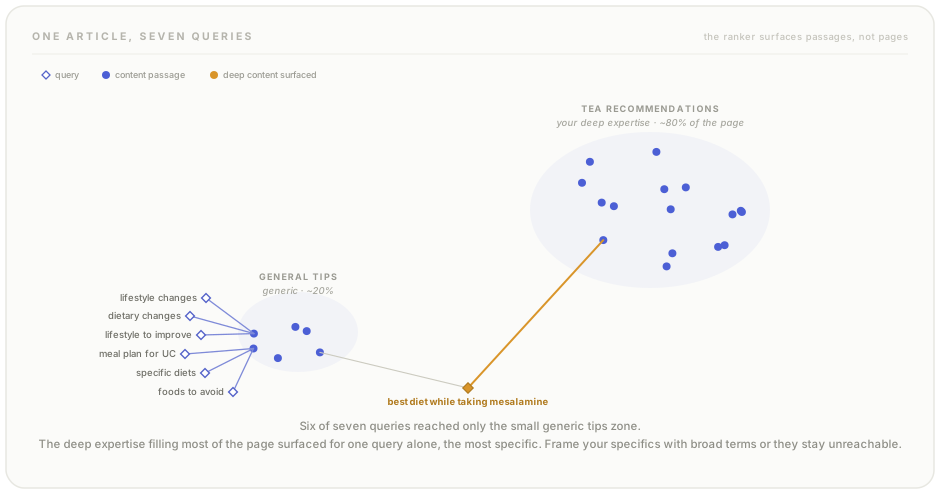
We ran seven query variations against one health article about teas for ulcerative colitis. The article has two distinct content zones: detailed information about four specific teas (~80% of content), and a general tips section about trigger foods, hydration, and smoothies (~20%).
Here’s what the ranker surfaced for extractive summarization:
QueryPassages Surfaced“Lifestyle changes for UC”Tips section“Dietary changes for UC”Tips section“Lifestyle changes to improve UC”Tips section“Create a meal plan for UC”Tips section“Specific diets for UC”Tips section“Foods to avoid with UC”Tips section + caffeine warnings from tea content“Best diet while taking mesalamine”Tea recommendations + tips sectionSix queries hit the tips section exclusively. One query—the most specific one—surfaced the article’s primary content.
The ranker evaluates semantic alignment between query and passage. It’s not broken. It’s doing its job.
“Lifestyle changes” and “dietary changes” are semantically closest to content about trigger foods, hydration strategies, and smoothies. That IS lifestyle and dietary guidance. The tea content is about specific beverages with specific compounds—a narrower semantic space.
The system correctly matched broad queries to broad content.
The revealing case is the mesalamine query: “What is the best diet to follow while taking mesalamine for ulcerative colitis?”
Mesalamine isn’t mentioned anywhere in the article. But this query surfaced the tea content that six other queries missed. Why?
Two factors:
1. “Best” signals recommendation-seeking intent. The user wants specific guidance, not general principles. The ranker surfaces passages that make specific recommendations—the tea content does exactly this.
2. The medication context implies an informed user. Someone mentioning their UC medication is past the “what is this condition” stage. They want actionable specifics. The detailed tea recommendations match this intent better than generic tips.
The query’s specificity unlocked a different semantic layer of the same document.
Another subtle finding: “Which foods should I avoid” pulled caffeine-related warnings from the tea sections that other queries missed.
The ranker found passages containing avoidance language: “caffeine is ideally skipped in a flare,” “caffeine is a stimulant and may lead to GI symptoms.”
Same document. Same tea content. But a negatively-framed query surfaced negative guidance that positively-framed queries (“what helps,” “what’s best”) did not.
Query framing isn’t just about topic—it’s about the polarity of the information need.
Your content exists as semantic topography. Different regions of your document live at different semantic coordinates. A query is a point in that space, and the ranker finds the nearest content.
This has three implications:
If your article has a detailed core and a summarized tips section, users asking broad questions will get the tips. This isn’t a failure—it’s alignment. But it means your deep expertise only surfaces for users who ask with matching specificity.
The gap between what you wrote and what gets surfaced is often a gap in query specificity, not content quality.
The article we tested has clear structural separation: tea content in the body, tips in a dedicated section. This creates distinct semantic regions.
If the tea recommendations had been interleaved with actionable lifestyle framing—”Add peppermint tea to your routine because…”—they might have competed for lifestyle queries. Structure determines discoverability.
A single article serves users at different stages of information-seeking:
Each group hits different semantic zones. The question is whether your content has something relevant at each coordinate—and whether it’s structured to be found there.
Audit your content for semantic coverage. Map the query intents your article should serve. Then check: does each intent have a semantically-aligned passage? Or does all your detail live in one zone that only specific queries reach?
Bridge your specifics to broader frames. If you want your detailed recommendations to surface for general queries, the passages need to include general framing. “Lifestyle changes for UC include specific tea choices—peppermint tea helps because…” bridges the semantic gap.
Consider polarity in your phrasing. If users commonly search with avoidance framing (“what to avoid,” “what not to eat”), ensure your content includes passages with that polarity. Positive-only framing may miss negatively-framed queries.
Specificity begets specificity. Your most detailed content surfaces for your most detailed queries. If your audience asks generically, they’ll get your generic layer. This might be fine—or it might mean your expertise is structurally invisible to most of your traffic.
This data shows the ranker working correctly. But “working correctly” means query-passage semantic matching—not “surfacing your best content.”
These are different objectives. The system optimizes for relevance to the query as asked. It has no model of what you, the content creator, consider your most valuable contribution.
The burden of alignment falls on content structure. If you want specific expertise to surface for general queries, the content itself needs to bridge that semantic distance.
The ranker isn’t ignoring your best content. Your users’ queries might be.
Analysis based on passage ranking patterns observed across query variations on a single source document.
url_prompt_snippet_analysisDownload
 Dan Petrovic ·
Dec 13, 13:17
Dan Petrovic ·
Dec 13, 13:17
Sign in with Google to comment.