Large language models act as a presentation layer on top of classic information retrieval. They rely on crawling, indexing, and ranking to prevent hallucinations.
There is a persistent myth that large language models, or LLMs, have completely replaced traditional search engines. But in reality, LLMs do not crawl the web, maintain indexes, or rank information at scale. Instead, classic information retrieval is still the backbone of search.
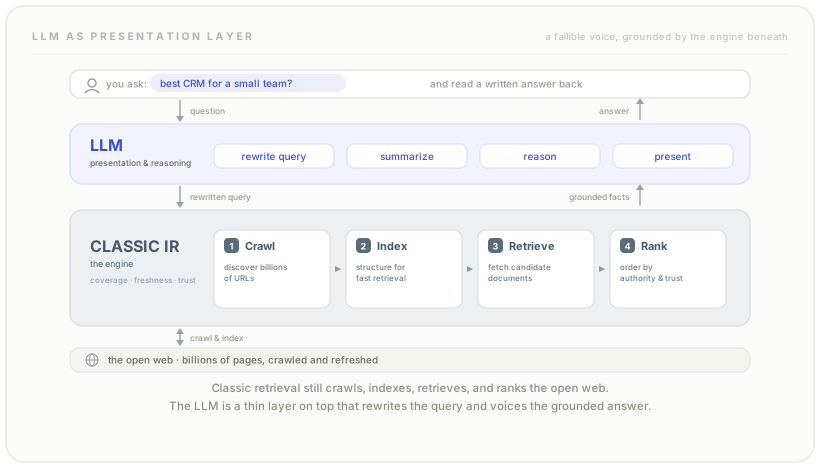
Classic search engines handle the heavy lifting: crawling the web, indexing content, retrieving documents, and ranking them for trustworthiness. What LLMs actually provide is a powerful interface on top of this machinery. They rewrite queries, summarize sources, and present answers in conversational language. They are the presentation layer, not the engine.
This distinction is crucial because generative models inevitably make things up. Recent research shows that hallucinations are a structural feature of LLMs, driven by statistical limits and evaluation benchmarks that reward guessing over staying silent. Without a grounding mechanism, an LLM cannot provide reliable search on its own.
To keep AI anchored in reality, we need a hybrid approach. Classic information retrieval supplies the facts, and techniques like retrieval-augmented generation feed these facts directly into the model. This allows the AI to cite real sources and reduces errors. Since we cannot completely eliminate hallucinations, the goal is to contain them through grounding, strict guardrails, and evaluation systems that reward accuracy over fluent guessing. LLMs have not replaced search. They have simply given it a brand new voice.
There is a persistent myth that large language models (LLMs) have fundamentally replaced search. In truth, LLMs do not crawl the web, do not maintain indexes, and do not enforce ranking algorithms at internet scale. They operate as presentation and reasoning layers on top of the classic information retrieval (IR) pipeline.
The recent paper Why Language Models Hallucinate (Kalai, Nachum, Vempala, Zhang, 2025) shows why this distinction matters: LLMs inevitably hallucinate due to statistical limits and evaluation incentives. Without grounding in real retrieval systems, they cannot provide reliable search.
Search systems still rely on four core steps:
This infrastructure guarantees coverage, freshness, and trustworthiness. It is the foundation on which all AI-driven search layers are built.
What LLMs add is not a new IR backbone but an interface:
In short, the LLM is the answer formatter and reasoning surface, not the crawler, not the indexer, not the ranker.
The Kalai et al. paper demonstrates that hallucinations are unavoidable in generative models:
This makes it clear: without a grounding mechanism such as retrieval or domain-specific corpora, LLMs will generate misinformation. Classic IR remains essential for anchoring them to factual reality.
Search engines provide the corrective layer that LLMs need:
Still, as Kalai et al. stress, hallucinations persist if incentives do not change. Even grounded models will guess unless evaluation frameworks reward caution, confidence calibration, and abstention.
Modern AI search blends the two:
This hybrid design recognizes that hallucinations are inherent to LLMs, and containment rather than elimination is the real goal.
LLMs have not replaced search. They have simply changed its surface. The invisible machinery of crawling, indexing, retrieval, and ranking remains in the domain of search engines. LLMs are the presentation layer of AI search, a powerful but fallible interface.
As Kalai et al. argue, hallucinations are a structural feature, not a bug. The task ahead is not to dream of hallucination-free LLMs, but to contain risk with grounding, guardrails, and evaluation systems aligned to truth.
 Dan Petrovic ·
Sep 21, 16:43
Dan Petrovic ·
Sep 21, 16:43

Phenomenal job of breaking down a complex topic.
I’d assume the indices will look a lot different than what exists today, and why companies are paying for licensing content.