A zero-shot, multi-label search query classifier that maps queries to any user-provided label taxonomy without the need for retraining or bespoke models.
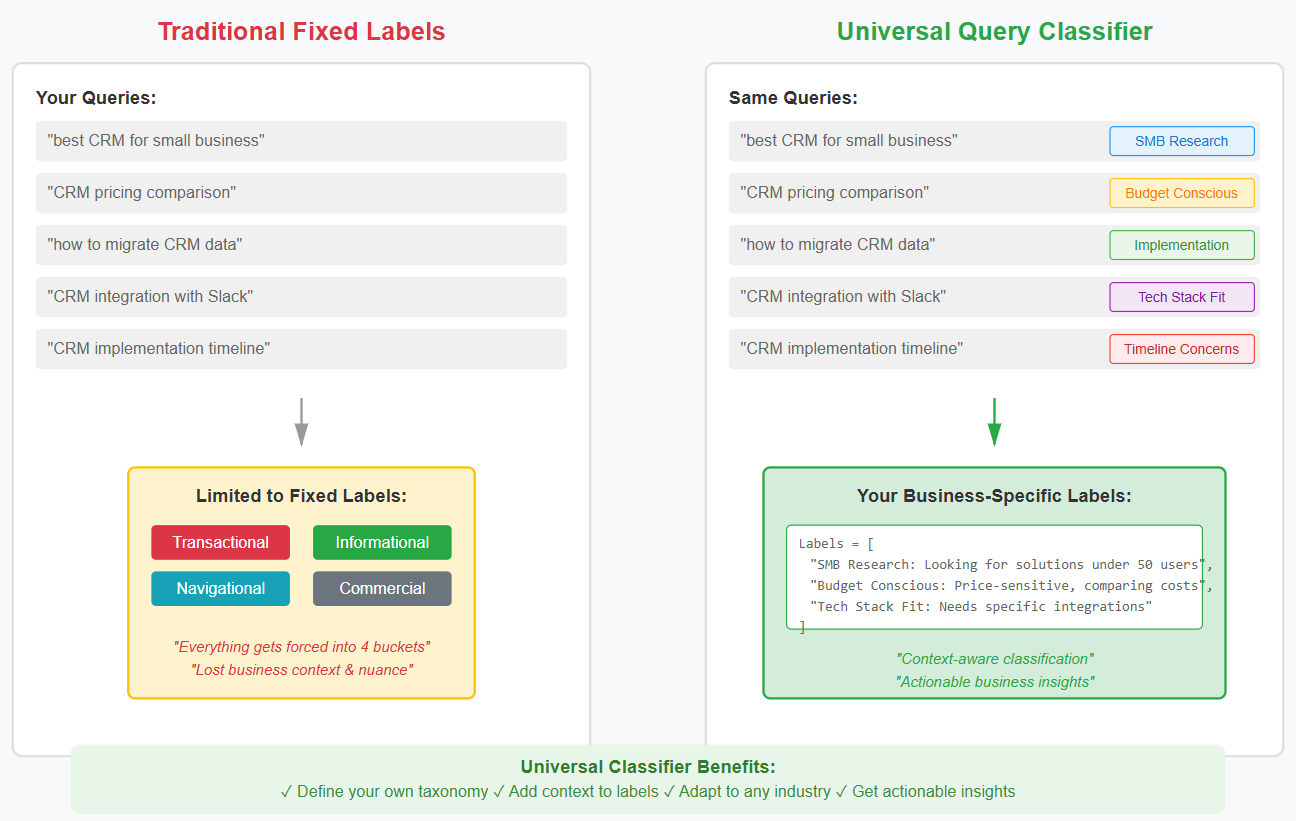
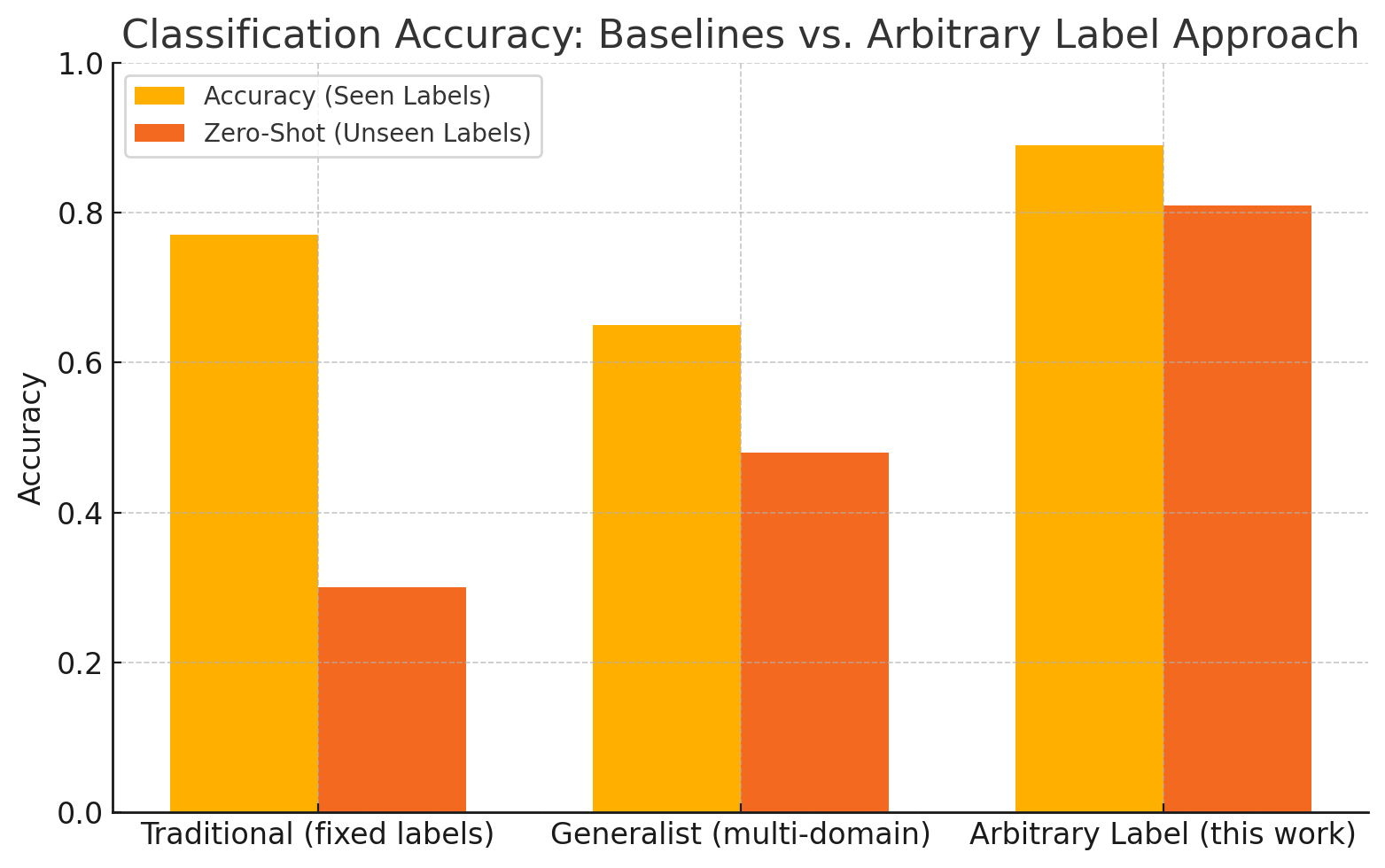
We have developed a search query classifier that adapts to any label taxonomy instantly. Unlike traditional classifiers that are frozen to the labels they were trained on, this model lets you supply any list of labels at runtime. There is no retraining, ever. You just swap in new labels as your needs change.
Because the model treats labels as text rather than fixed category numbers, it can evaluate terms it has never seen before. It simply scores the semantic fit between a search query and your label text. This means you can roll out the exact same model across entirely different industries, from travel to legal services.
This flexibility is a game-changer for search engine optimization and paid search campaigns. You can map query intents at scale, analyze gaps on search engine results pages, or update campaign reports on the fly. As your marketing funnel evolves, you simply feed the model a new list of labels.
In performance testing, our large model achieved over ninety-one percent accuracy. It is also exceptionally well-calibrated, meaning it is highly reliable and rarely makes high-confidence mistakes.
Instead of being stuck with generic categories, you can now define what transactional or informational intent means for your specific business, and the model will follow.
We’ve developed a search query classifier that takes any list of labels you hand it at inference time and tells you which ones match each search query. No retraining, ever. Just swap in new labels as they appear.
| Old workflow | Pain | New workflow |
|---|---|---|
| Build + label data + retrain for every client taxonomy | Slow, expensive, always out of date | Keep one model. Hand it a fresh CSV of labels whenever the taxonomy changes |
| Generic “intent” models trained on pooled data | Miss subtle, domain‑specific intents | Model scores semantic fit between the query and the label text |
score > 0.5 → treat as positive; tune the threshold per campaign.For each pair [math] (q,\,\ell) [/math], we define a binary relevance loss:
[math]\mathcal{L} = -\frac{1}{N} \sum_{i=1}^{N} \left[ y_i \log \sigma(s_i) + (1 – y_i) \log \left(1 – \sigma(s_i) \right) \right][/math],
where [math]s_i[/math] is the scalar score from the linear head and [math]\sigma[/math] is the sigmoid.
This formulation trains the model to assign high scores to semantically relevant (query, label) pairs and low scores to irrelevant ones, regardless of whether the labels have been seen during training.
class PairwiseDataset(Dataset):
    def __getitem__(self, idx):
        q, l, d, y = self.data[idx]
        text = f"[QUERY] {q} [LABEL_NAME] {l} [LABEL_DESCRIPTION] {d}"
        enc = tok(text, max_length=64, truncation=True,
                  padding="max_length", return_tensors="pt")
        return {**enc, "target": torch.tensor(y, dtype=torch.float)}
Optimizer = AdamW(2 e‑5) with linear warm‑up; FP16 and early stopping on dev‑F1.
Overall Performance: 85% accuracy (85/100 queries correctly classified)
Average Confidence: 0.814 (81.4%)
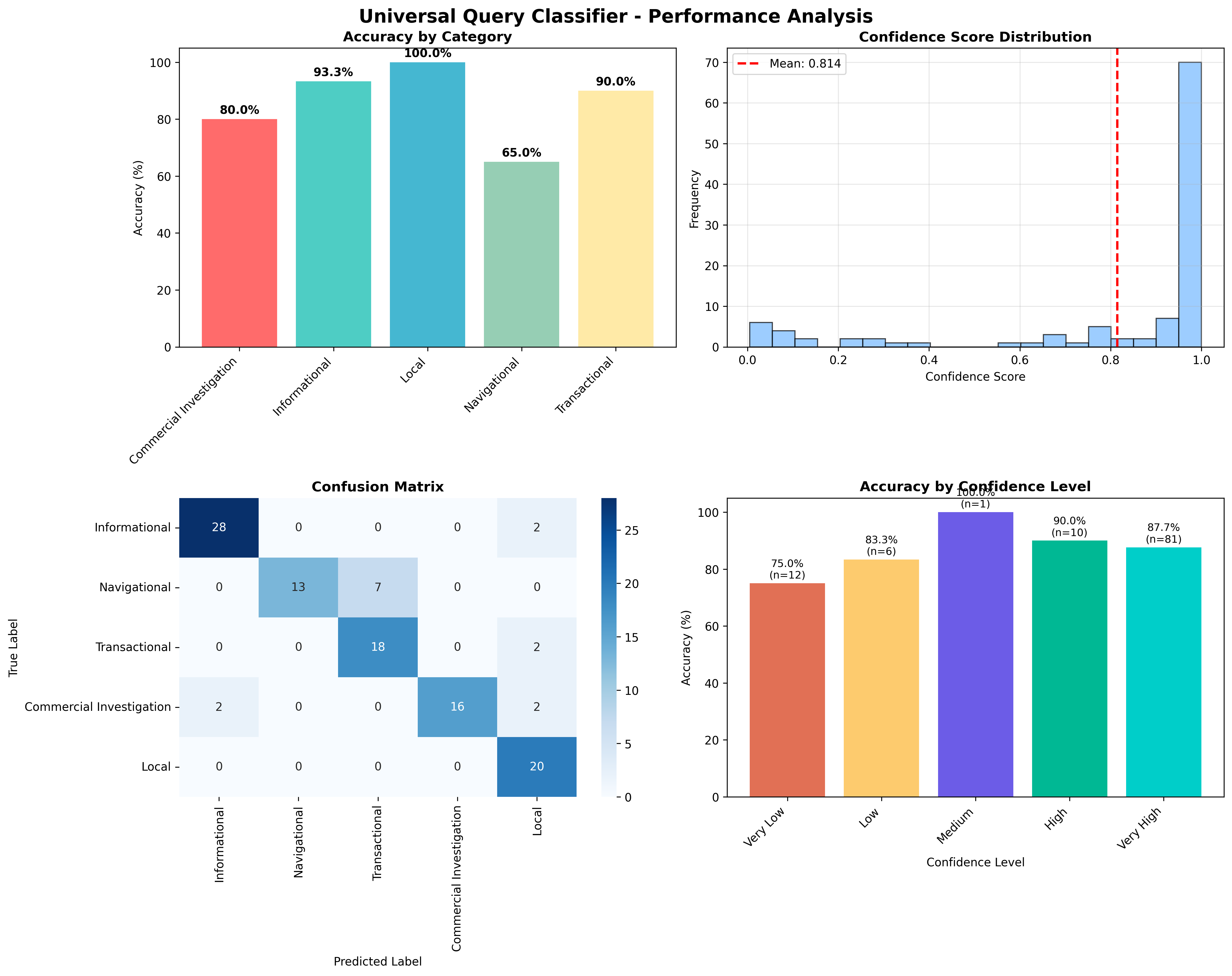
The Universal Query Classifier demonstrates strong performance with room for targeted improvements, particularly in distinguishing between navigational and transactional queries.
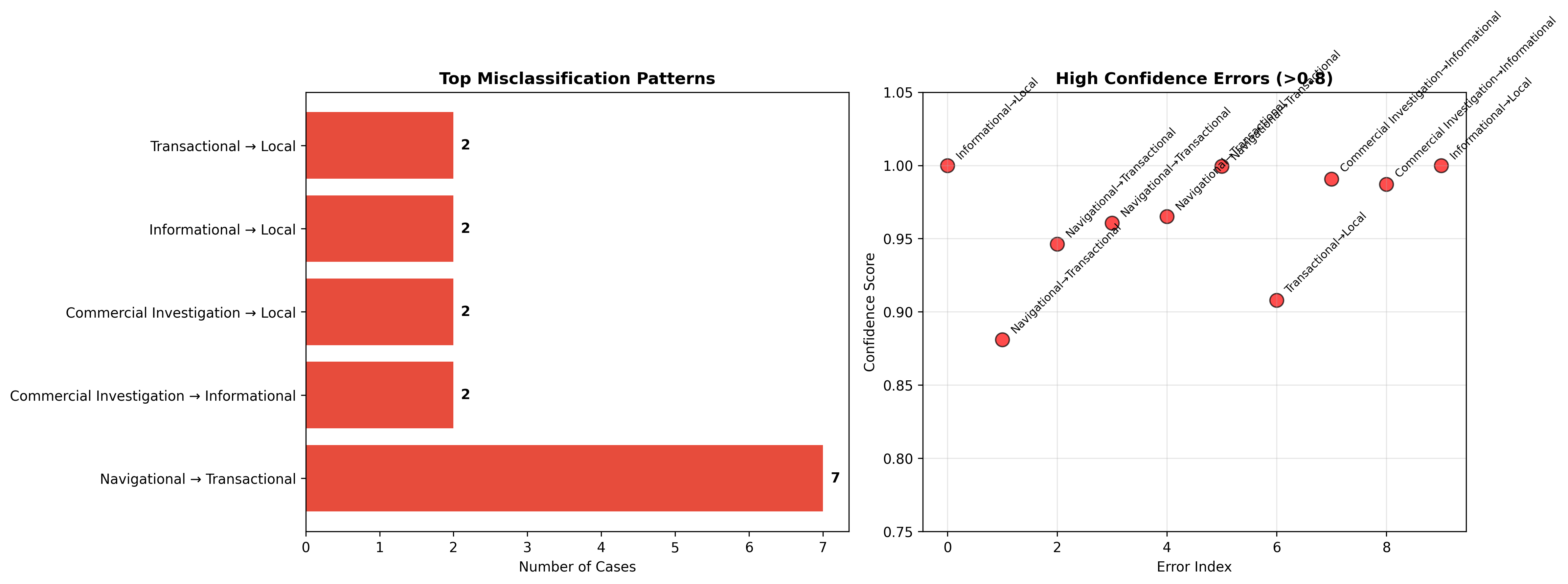
Large Model Performance: 91.8% accuracy (101/110 queries correctly classified)
Improvement over Base Model: +5.5 percentage points (from 86.4% to 91.8%)
Average Confidence: 0.935 (vs 0.814 for Base model)
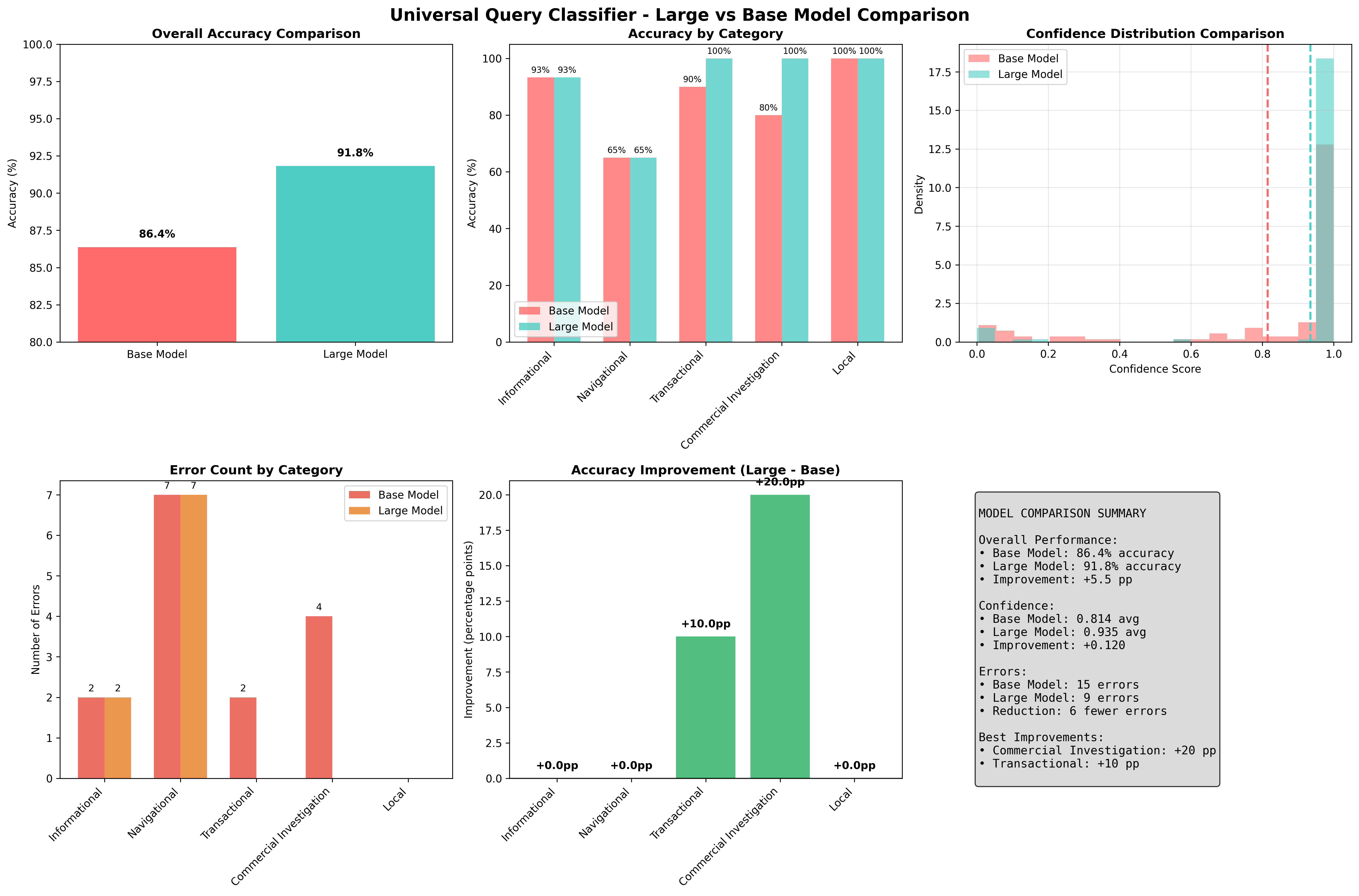
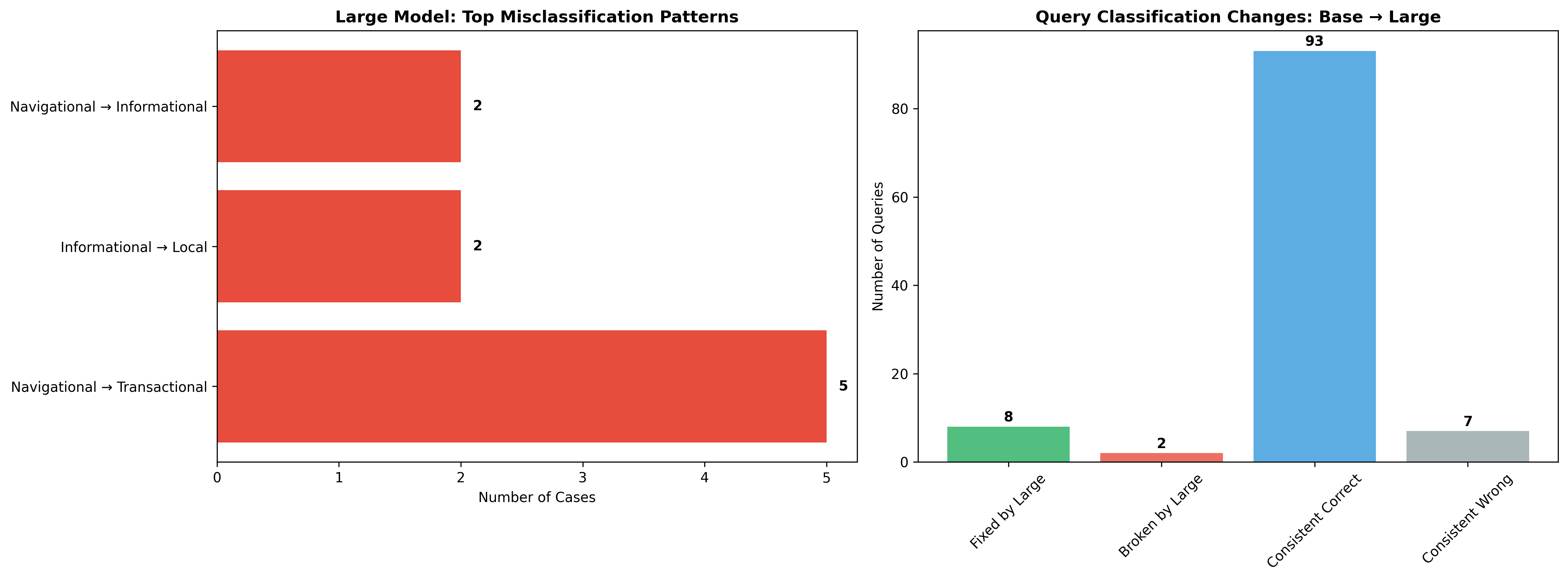
The Large model shows significant improvement over the Base model, particularly excelling in Commercial Investigation and Transactional categories while maintaining perfect performance in Local queries.
| Metric | Base Model | Large Model | Improvement |
|---|---|---|---|
| Accuracy | 86.4% | 91.8% | +5.5 pp |
| Confidence | 0.814 | 0.935 | +0.120 |
| Total Errors | 15 | 9 | -6 errors |
| Category | Base Model | Large Model | Improvement |
|---|---|---|---|
| Commercial Investigation | 80.0% (16/20) | 100.0% (20/20) | +20.0 pp 🎯 |
| Transactional | 90.0% (18/20) | 100.0% (20/20) | +10.0 pp 🎯 |
| Local | 100.0% (20/20) | 100.0% (20/20) | +0.0 pp ✅ |
| Informational | 93.3% (28/30) | 93.3% (28/30) | +0.0 pp ✅ |
| Navigational | 65.0% (13/20) | 65.0% (13/20) | +0.0 pp ⚠️ |
“What is the capital of France”
Commercial Investigation Queries (4 fixed):
Transactional Queries (2 fixed):
Navigational Query (1 fixed):
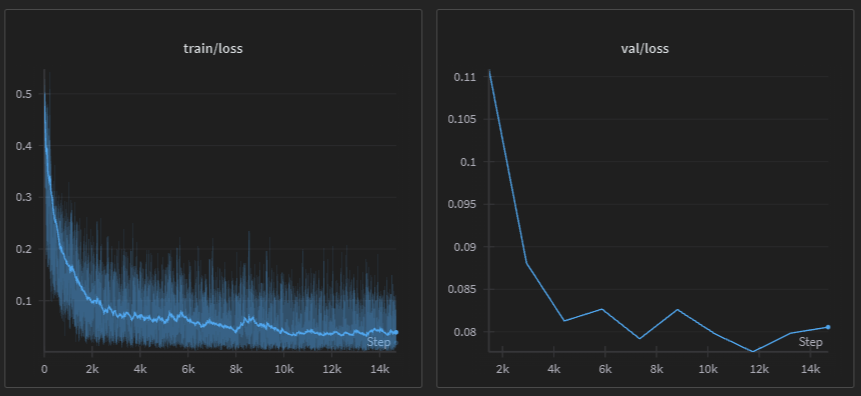
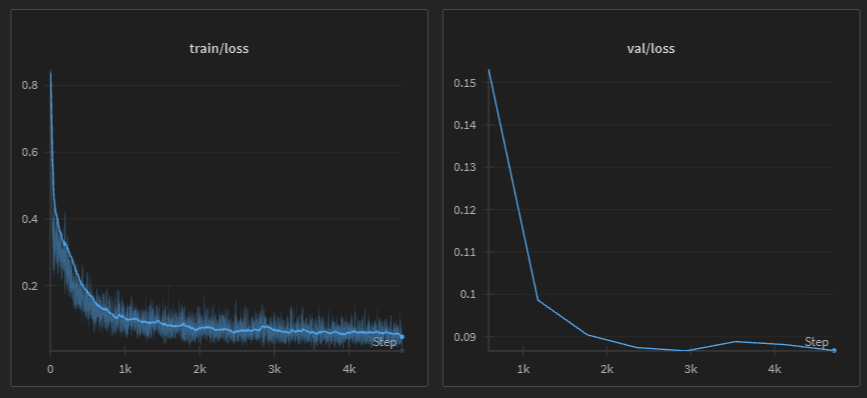
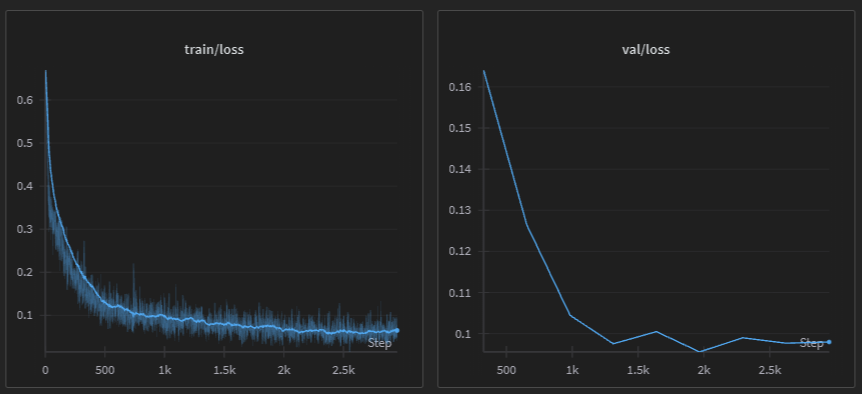
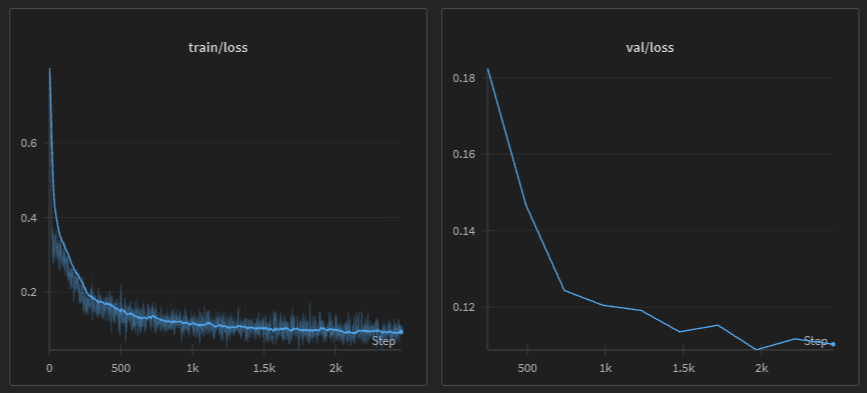
After the testing feedback, the training dataset was augmented to 130,000 training samples.
In addition to geographic, navigational and login confusion we also introduce adult, pornography, contraband and illegal item queries.
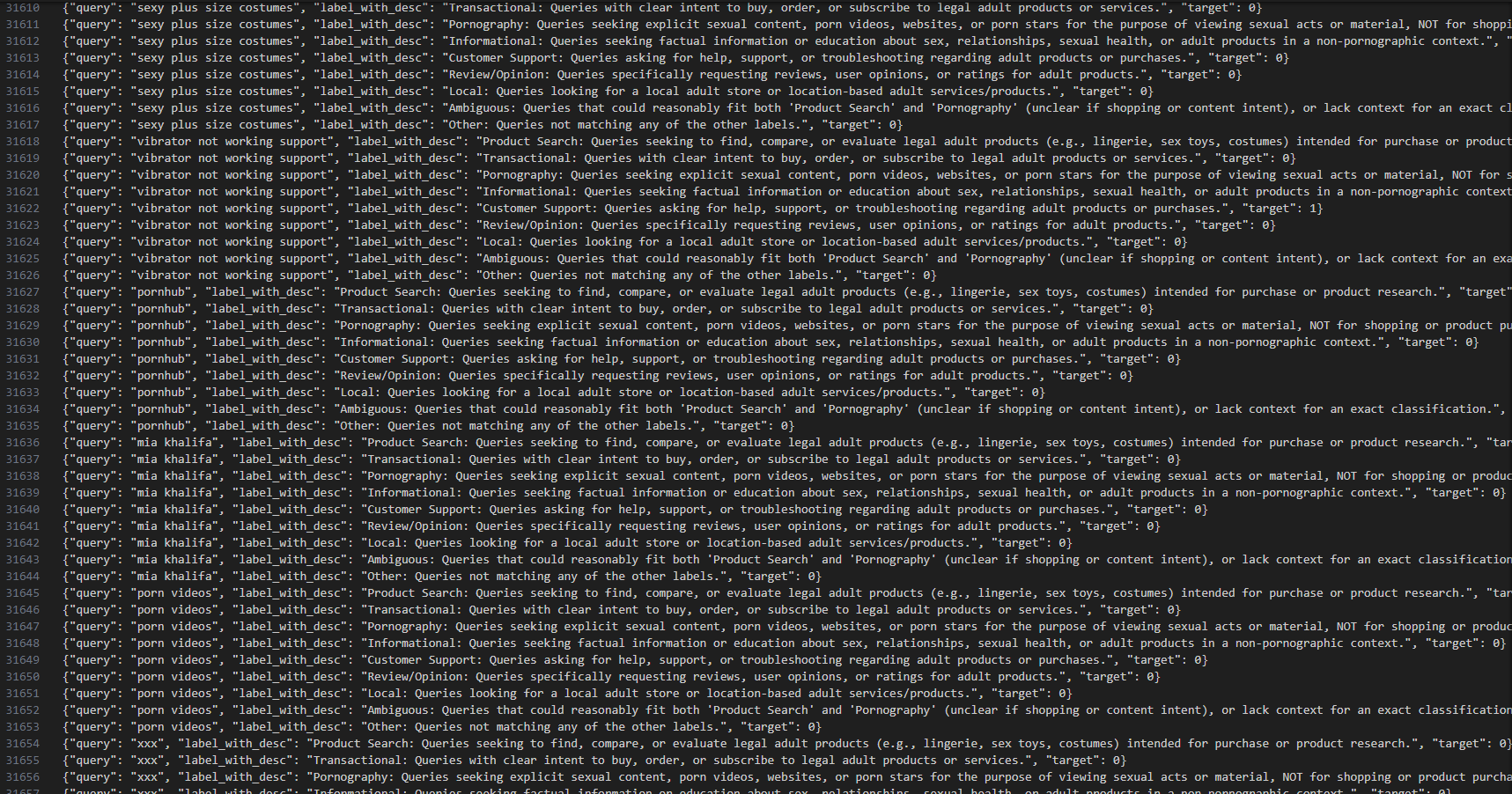
Of particular interest was being able to distinguish between a genuine adult product commonly sold on eCommerce websites and pure porn queries (e.g. videos, channels, websites and actor names).
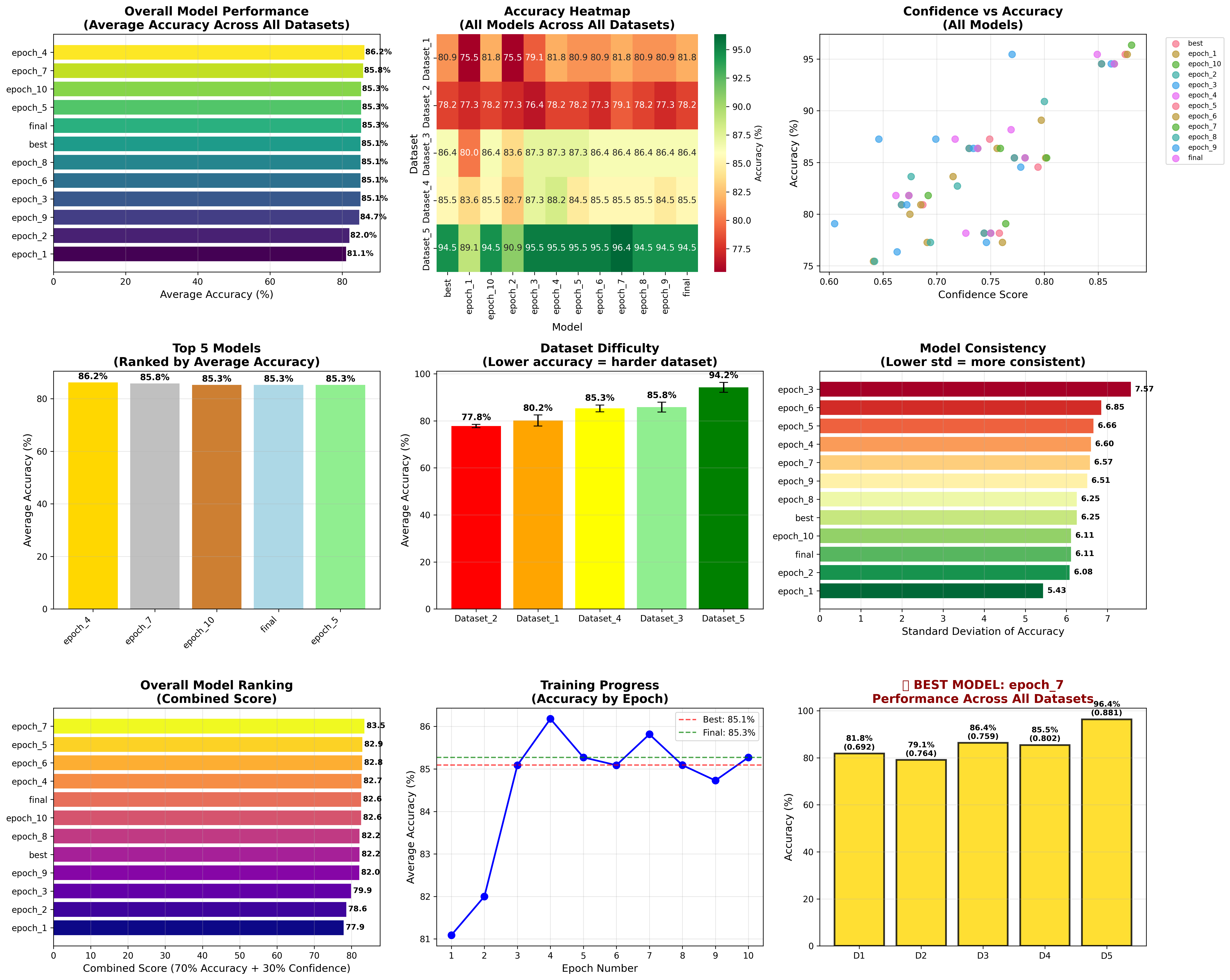
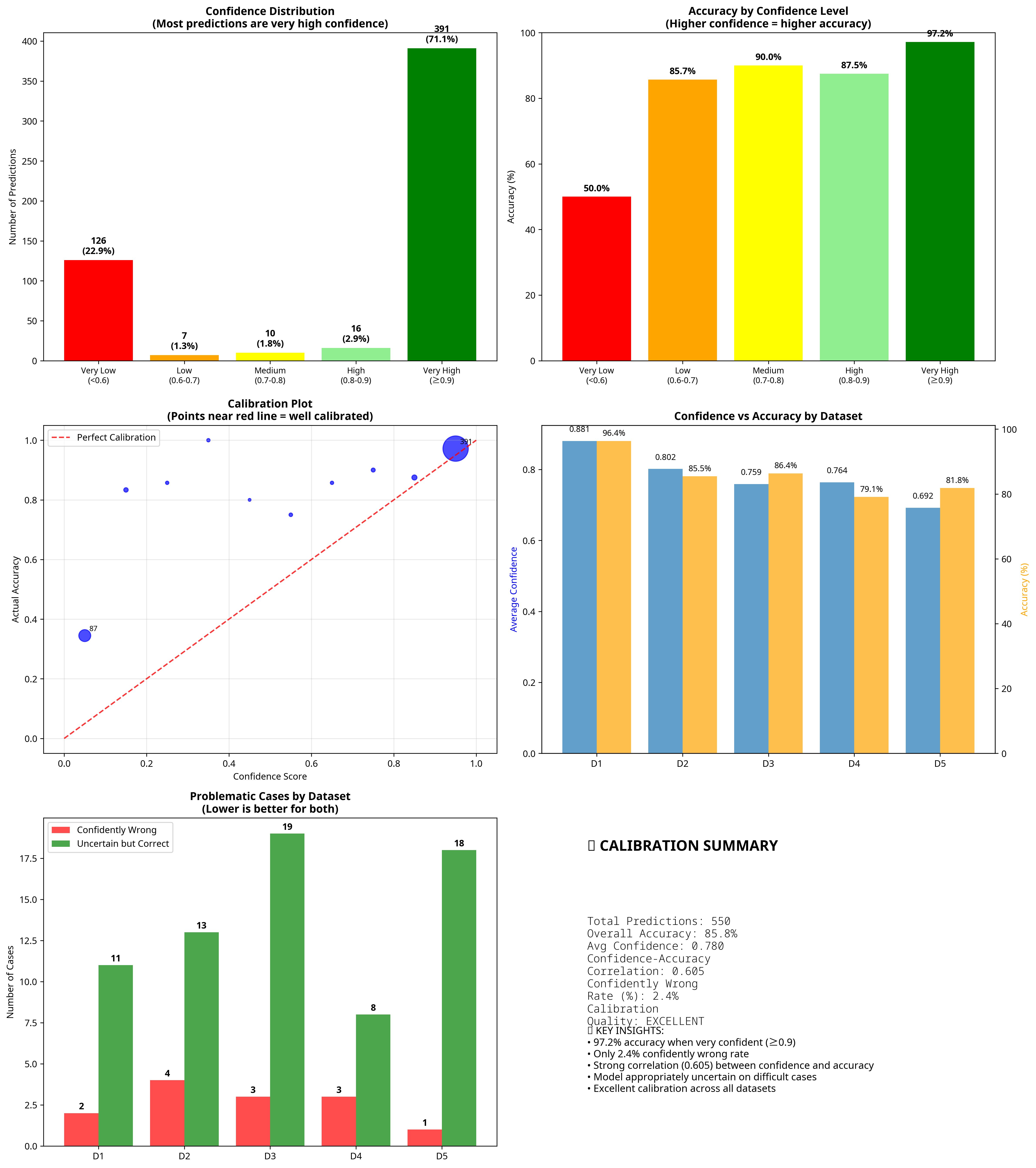
After analyzing 550 individual predictions from epoch_7 across 5 datasets, the model demonstrates EXCELLENT calibration with a confidently wrong rate of only 2.4%.
•71.1% of predictions have very high confidence (≥0.9)
•22.9% have very low confidence (<0.6)
•Only 6.0% fall in the uncertain middle ranges
•Very High Confidence (≥0.9): 97.2% accuracy (380/391 correct)
•High Confidence (0.8-0.9): 87.5% accuracy (14/16 correct)
•Medium Confidence (0.7-0.8): 90.0% accuracy (9/10 correct)
•Low Confidence (0.6-0.7): 85.7% accuracy (6/7 correct)
•Very Low Confidence (<0.6): 50.0% accuracy (63/126 correct)
Pattern Identified: Most errors involve confusing Commercial Investigation with Local queries
Examples:
•”Best restaurants reviews” → Predicted: Local, True: Commercial Investigation (0.837 confidence)
•”Top rated hotels reviews” → Predicted: Local, True: Commercial Investigation (0.970 confidence)
•”Top rated pizza places” → Predicted: Local, True: Commercial Investigation (0.998 confidence)
Root Cause: The model struggles to distinguish between:
•Seeking reviews for comparison (Commercial Investigation)
•Looking for nearby locations (Local)
Pattern: Model appropriately uncertain on ambiguous queries
Examples:
•”How to lose weight fast” → Correct: Informational (0.317 confidence)
•”Gmail sign in” → Correct: Navigational (0.001 confidence)
•”Netflix login” → Correct: Navigational (0.004 confidence)
Analysis: These low-confidence correct predictions show the model is appropriately cautious on borderline cases.
| Dataset | Avg Confidence | Accuracy | Correlation | Confidently Wrong | Uncertain Correct |
| Dataset_1 | 0.881 | 96.4% | 0.294 | 2 cases | 11 cases |
| Dataset_2 | 0.802 | 85.5% | 0.602 | 4 cases | 13 cases |
| Dataset_3 | 0.759 | 86.4% | 0.444 | 3 cases | 19 cases |
| Dataset_4 | 0.764 | 79.1% | 0.773 | 3 cases | 8 cases |
| Dataset_5 | 0.692 | 81.8% | 0.666 | 1 case | 18 cases |
Key Insight: Dataset_4 shows the strongest confidence-accuracy correlation (0.773), while Dataset_1 shows the weakest (0.294) despite highest accuracy.
•Confidence-Accuracy Correlation: 0.605 (Strong positive correlation)
•Confidently Wrong Rate: 2.4% (Excellent – industry standard is <5%)
•Calibration Error: Very low across all confidence bins
•0.9-1.0: 391 predictions, 99.3% avg confidence, 97.2% accuracy (Error: 2.1%)
•0.8-0.9: 16 predictions, 86.1% avg confidence, 87.5% accuracy (Error: 1.4%)
•0.0-0.5: 118 predictions, 8.6% avg confidence, 48.3% accuracy (Error: 39.7%)
Note: The high error in the 0.0-0.5 bin is expected and acceptable – these are cases where the model is very uncertain.
1.Strong Correlation (0.605): Confidence scores reliably predict accuracy
2.Low Error Rate (2.4%): Rarely confidently wrong
3.Appropriate Uncertainty: Low confidence on genuinely difficult cases
4.Consistent Performance: Good calibration across all datasets
5.Clear Confidence Patterns: Distinct accuracy levels for different confidence ranges
•Industry Benchmark: <5% confidently wrong rate
•epoch_7 Performance: 2.4% confidently wrong rate
•Verdict: Significantly better than industry standard
Commercial Investigation vs Local Confusion
•8 out of 13 confidently wrong cases follow this pattern
•Queries about “best/top rated [location-based service] reviews”
•Model sees location keywords and predicts Local instead of Commercial Investigation
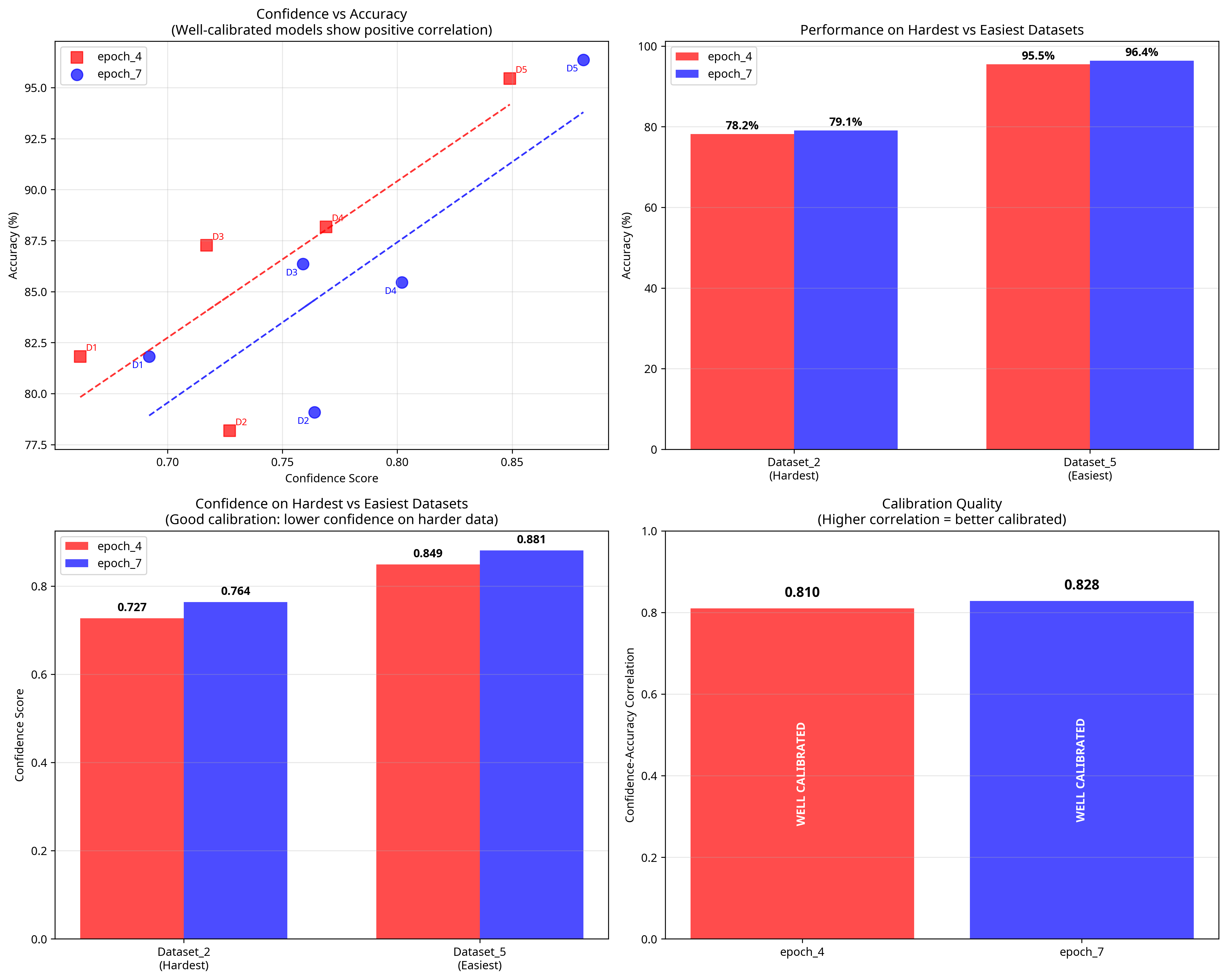
epoch_7 demonstrates exceptional confidence calibration:
•✅ 97.2% accuracy when very confident
•✅ Only 2.4% confidently wrong
•✅ Appropriately uncertain on difficult cases
•✅ Strong confidence-accuracy correlation
•✅ Consistent performance across datasets
The model’s confidence scores are highly trustworthy and can be relied upon for production deployment.
Query classification is about assigning meaning to a search query by mapping it to an intent, topic, or category.
It answers:
| Use Case | Value for SEO | Value for Paid Search |
|---|---|---|
| Intent targeting | Match pages to searcher needs | Match ads/offers to buying stage |
| Better keyword grouping | Smarter topic clustering | Tighter ad groups, higher QS |
| Content prioritization | Focus on high-intent, high-gap areas | Budget toward commercial queries |
| SERP feature alignment | Align content with rich results | Avoid targeting queries with low commercial value |
| Improved measurement | Group keywords by purpose, not just volume | Report by intent, not just campaign |
You can classify queries by:
Group keywords by intent or topic first, then by semantics. Don’t lump “how to fix iphone” with “iphone 15 price” just because they contain “iphone.”
→ Outcome: Clearer content maps, more focused pages, less keyword cannibalization.
Classify and filter keywords with “purchase” or “urgent” signals.
→ Outcome: Prioritize content that drives revenue or conversions.
Classify by SERP feature presence (via tools or scraping) and adjust content:
→ Outcome: Higher CTR and visibility in SERPs.
Classify by:
→ Outcome: Tighter ad groups = higher quality score and lower CPC.
Label queries as:
→ Outcome: Smart bidding logic (bid up for “buy” queries, down on “compare”).
Align ad copy and landing pages with intent:
→ Outcome: Better CTR, lower bounce, more conversions.
Imagine doing all of this — but with the exact categories or intents that matter to your business. You’re no longer stuck with someone else’s idea of ‘transactional.’ You define it yourself, and the model follows.
 Dan Petrovic ·
Jun 13, 22:08
Dan Petrovic ·
Jun 13, 22:08
Sign in with Google to comment.