Social media poll results from 864 votes show that while AI is the dominant label for tools like ChatGPT and Claude, users remain divided on preferred terms.
What do you call tools like ChatGPT, Claude, Gemini, and Perplexity? A recent social media poll of over eight hundred people shows we are still trying to figure that out.
By far, the most popular term is simply AI, which took over seventy percent of the vote. A much smaller group, about twelve percent, prefers the term chatbots, while roughly eight percent opt for AI assistants.
About one in ten respondents wanted something else entirely. This group offered a wide mix of labels. Some went technical, using terms like large language models. Others chose functional names like conversational search, while some used playful nicknames or expressed outright skepticism.
Even the creators of these tools cannot agree on a single name. ChatGPT and Gemini often refer to themselves as large language models. Claude and Deep Seek call themselves AI assistants, and Perplexity calls itself an answer engine.
This fragmentation shows just how unsettled our language remains. Whether we lean toward broad, technical, or playful terms, the words we choose reflect our differing comfort levels with this rapidly evolving technology.
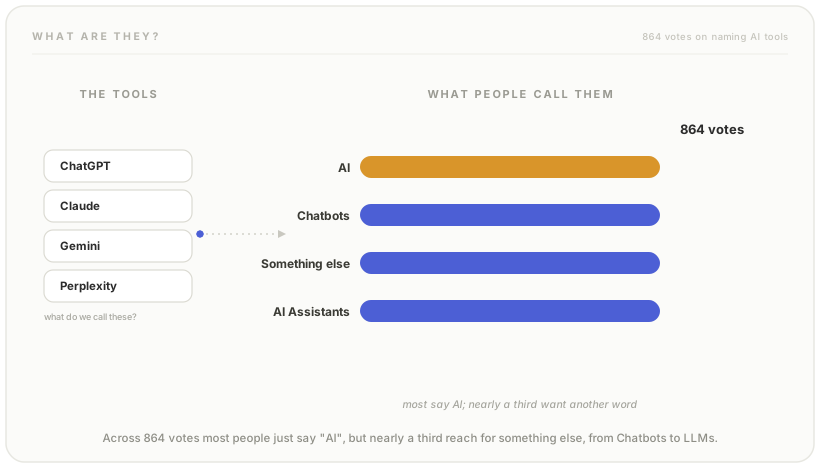
Across 864 total votes collected on social media polls, respondents gave a fragmented view on how to label tools like ChatGPT, Claude, Gemini, and Perplexity.
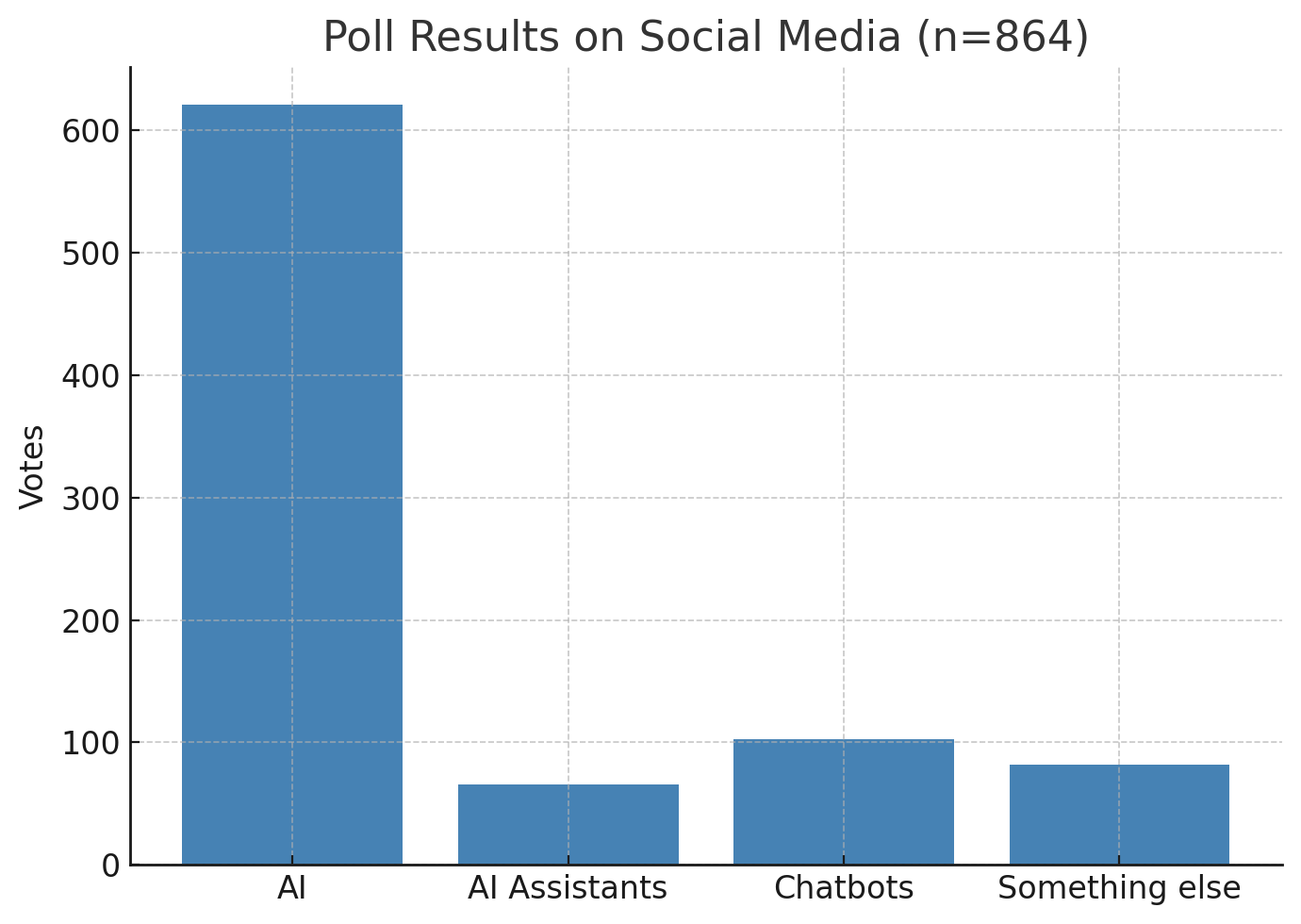
Results:
Overall, the dominant label is still AI, though notable minorities prefer “Chatbots,” “AI Assistants,” or alternative terms.
Participants who chose Something else or expanded in comments offered a wide spectrum of terminology:
With 864 votes, “AI” clearly leads as the common label, but nearly a third of respondents want something else—whether more accurate, more functional, or outright rejecting the framing. The debate illustrates how unsettled language remains around these systems, reflecting differences between technical precision, everyday usability, and cultural attitudes.
 Dan Petrovic ·
Aug 16, 21:48
Dan Petrovic ·
Aug 16, 21:48
Sign in with Google to comment.