Google's EmbeddingGemma is a multilingual embedding model that mirrors Gemini's architecture to provide insights into semantic search and query intent.
Google recently released EmbeddingGemma, a multilingual embedding model that gives us a direct window into how search engines understand the world. Because this model is a compact version of Gemini, the artificial intelligence behind Google's advanced search capabilities, studying it helps search engine optimization professionals see exactly how Google processes information.
Instead of just matching keywords, modern search systems use embedding models to translate text into mathematical vectors. This lets the system capture true user intent, semantic relationships, and context. EmbeddingGemma stands out because it is highly efficient. It features over three hundred million parameters, supports more than one hundred languages, and uses a technique called Matryoshka learning. This allows the model to compress its search data on demand without losing accuracy, leading to faster calculations and lower storage costs.
By analyzing these open-source models, researchers can now build custom tools to map search behavior and predict query variations. We are even beginning to see how specific neural circuits in these models activate for brand names or content quality.
The era of simple keyword tracking is fading. The future of search optimization belongs to those who understand semantic relationships, retrieval-augmented generation, and the underlying AI models that connect users to content. EmbeddingGemma is a powerful tool to help us navigate this new landscape.
In the business of Gen AI search optimization, staying ahead means understanding the underlying technologies that power modern search systems. Today, Google has released EmbeddingGemma, a ground-breaking multilingual embedding model that represents a key piece of the puzzle for anyone serious about understanding how Google processes and retrieves information.
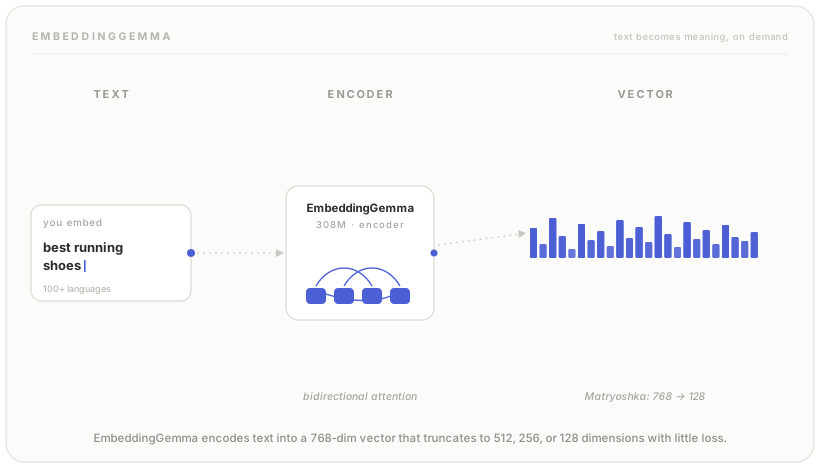
Here’s what every SEO professional needs to understand: EmbeddingGemma is essentially a miniaturized version of Gemini, and Gemini is the AI powerhouse behind Google’s advanced search capabilities. This isn’t just another language model-it’s a window into how Google’s search infrastructure actually works.
Think of it this way:
Embedding models transform text into dense mathematical representations (vectors) that capture meaning, intent, and relationships. When Google processes a search query or crawls your content, it’s not just matching keywords-it’s creating these semantic embeddings to understand:
With over 200 million monthly downloads of embedding models on Hugging Face, this technology has become the backbone of modern NLP applications. EmbeddingGemma’s release gives us unprecedented access to technology that mirrors Google’s internal systems.
EmbeddingGemma represents a technical breakthrough with several key innovations:
Core Specifications:
One of EmbeddingGemma’s most innovative features is Matryoshka Representation Learning (MRL). This allows the 768-dimensional embeddings to be truncated to 512, 256, or even 128 dimensions on demand-without significant performance loss. For SEO applications, this means:
Vector Embedding Optimization
On the Massive Text Embedding Benchmark (MTEB), EmbeddingGemma achieves state-of-the-art performance for models under 500M parameters. This isn’t just academic-it translates to:
EmbeddingGemma uses specific prompts to distinguish between different tasks:
"task: search result | query: ""title: none | text: ""task: clustering | query: ""task: classification | query: "Understanding these prompts is crucial for SEO professionals who want to analyze how their content might be embedded and understood by Google’s systems.
Training Gemma‑3‑1B Embedding Model with LoRA
At Dejan AI, we’ve taken a pioneering approach to understanding and leveraging embedding models for SEO advantage. Our work with Gemma embeddings has focused on two critical areas:
We’ve developed Gemma-Embed, our proprietary 256-dimensional embedding model built by fine-tuning google/gemma-3-1b-pt with LoRA (Low-Rank Adaptation) techniques. This custom approach allows us to:
Architecture Innovations:
Our training methodology demonstrates how specialized embedding models can be created for specific SEO tasks:
Training a Query Fan-Out Model
One of our most significant breakthroughs has been using these custom embeddings for query fan-out-generating hundreds of semantically related query variations from a single seed query. This technology enables:
Our production system processes millions of queries, demonstrating that custom embedding models aren’t just research projects-they’re practical tools for SEO at scale. The ability to navigate the embedding space between queries and documents has revolutionized our approach to:
Perhaps the most exciting frontier opened by EmbeddingGemma is the possibility of mechanistic interpretability-understanding not just what these models do, but how they do it. At Dejan AI, we’ve developed a comprehensive framework for cross-model circuit analysis between Gemini and Gemma model families.
Cross-Model Circuit Analysis: Gemini vs. Gemma Comparison Framework
Our research into mechanistic interpretability focuses on several key areas:
1. Circuit Universality
We’re identifying “brand circuits”-neural pathways that consistently activate when processing brand-related information. These insights reveal:
2. Architectural Influences
By comparing Gemini and Gemma architectures, we’re uncovering:
3. Attention Pattern Analysis
Our analysis reveals fascinating patterns in how models pay attention:
This mechanistic understanding translates into actionable SEO strategies:
Content Optimization Insights:
Query Understanding:
Brand Positioning:
One of our most significant findings is that insights from one model often transfer to others. This means:
Beyond Rank Tracking: Analyzing Brand Perceptions Through Language Model Association Networks
Understanding embedding models like EmbeddingGemma isn’t just about current optimization-it’s about preparing for the future of search:
For serious SEO teams, consider:
EmbeddingGemma represents more than just another AI model release-it’s a window into the future of search. For SEO professionals, understanding and leveraging this technology isn’t optional; it’s essential for staying competitive.
The combination of:
…makes EmbeddingGemma a game-changer for anyone serious about search optimization.
At Dejan AI, we’re not just observing this revolution-we’re actively participating by:
The message is clear: The future of SEO lies not in gaming algorithms, but in understanding the fundamental technologies that power modern search. EmbeddingGemma gives us unprecedented access to these technologies. The question isn’t whether to adopt these capabilities-it’s how quickly you can integrate them into your SEO strategy.
 Dan Petrovic ·
Sep 05, 08:37
Dan Petrovic ·
Sep 05, 08:37
Sign in with Google to comment.