Traditional SEO was all about ranking in a list of links. But today, there is a new goal: AI Visibility. This means being seen, cited, and recommended directly inside the answers that AI systems generate for users. It is about whether your brand, your pages, and your ideas show up when a language model responds to a question.
Instead of a single ranking number, AI Visibility is measured through a mix of signals. These mainly split into two categories: mentions and citations. A mention is when the AI names your brand in its text. A citation is when it actually links or references your pages as a source.
To track this, you look at the raw number of times you are mentioned or cited, and your overall share of voice compared to your competitors. You can also measure your rank. In this context, rank is not about traditional search, but rather the specific order in which your brand or link appears within the AI's generated response.
You might hear this practice called by several names, including AI SEO, AI Optimization, Answer Engine Optimization, or Generative Engine Optimization. But whatever the name, the goal remains the same: making sure your brand is the one the AI chooses to talk about.
AI Visibility is the broad outcome that AI-centric SEO work aims to achieve. It means being seen, cited, and recommended by AI systems when they answer people's questions. Traditional SEO aimed at ranking in a list of links. AI Visibility aims at presence inside the generated answer itself: whether your brand, your pages, and your ideas show up when a language model responds, and how prominently they do.
It is a desired outcome rather than a single number. Underneath it sits a family of measurable signals that together tell you how visible you are across AI answers.
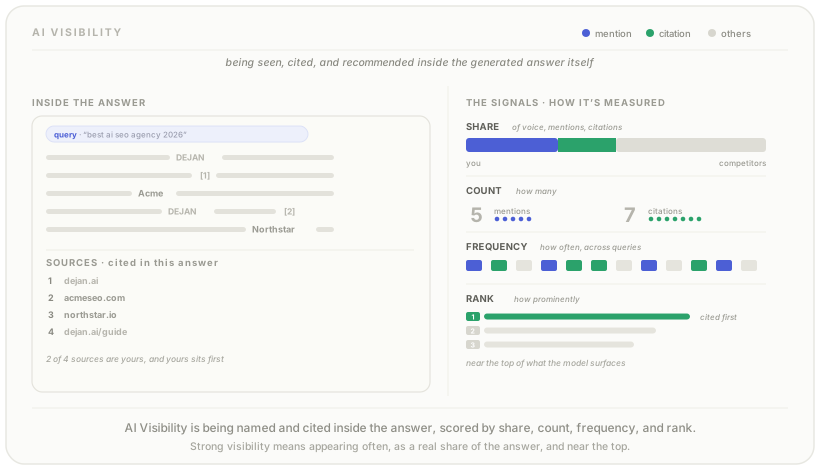
People track AI Visibility through a set of related metrics. These divide into two kinds of presence: mentions, where your brand is named in the answer, and citations, where your pages are linked or referenced as a source. Each kind is measured by share, by absolute count, by how often it happens, and by how prominently it appears.
The most basic AI visibility metric is the raw and exact count of brand mentions and citations in model responses.
Number of mentions.
The absolute count of times your brand is named.
Number of citations.
The absolute count of times your pages are cited.
Your overall slice of the AI answer space for a topic, relative to competitors.
Share of mentions.
The proportion of brand mentions in answers that are yours.
Share of citations.
The proportion of cited sources in answers that are yours.
Language model output presents as an ordered sequence of words and phrases in plain text. A rank represents a precise ordinal value of a specific brand, product or service relative to all others.
Important: Not to be confused with traditional search rankings.
Rank of mentions.
Ordinal value representing the exact position of your brand relative to other brands mentioned in model's response.
Rank of citations.
Ordinal value representing the exact position of your domain relative to all other citations in model's response.
AI Visibility is the outcome. These are common names for the practice of working toward it: